

Discovering Hanami in Japan is entering one of the most fascinating traditions in the world. Beyond the spectacle of sakura, this journey invites you to explore Japan in spring from a perspective of sustainable tourism, slow travel, and conscious luxury, through places where nature, heritage, and culture converge in harmony. An experience in which ephemeral beauty transforms the way of traveling and reveals that, beyond the pink postcard, Hanami in Japan is a profound lesson in impermanence.

Mono no aware and the meaning of Hanami in Japan.
In Japanese culture, there is a fundamental concept, Mono no aware (物の哀れ), which can be translated as sensitivity to the ephemeral beauty of things. It accepts that nothing is permanent and, far from generating sadness, turns each moment into something deeply valuable.
It is the sigh that arises when contemplating a flower at its peak, knowing that it will soon disappear. This principle is the foundation of disciplines such as the tea ceremony, floral arrangements (ikebana), and Hanami itself, the tradition of contemplating cherry blossom blooming (sakura) in Japan, where the beauty of falling petals evokes the transience of existence.
Hanami is not just about observing flowers. It is about understanding the transience of life.
In a context where travelers increasingly seek to travel to Japan sustainably, this tradition invites them to go beyond photography. It proposes observing, respecting, and becoming part of the balance of the environment.
An invitation to travel from a more conscious perspective, aligned with the principles we promote at Biosphere through the Biosphere Certified label (for companies) and the Biosphere Certified Destination distinction (for destinations), and in line with the United Nations Sustainable Development Goals (SDGs).
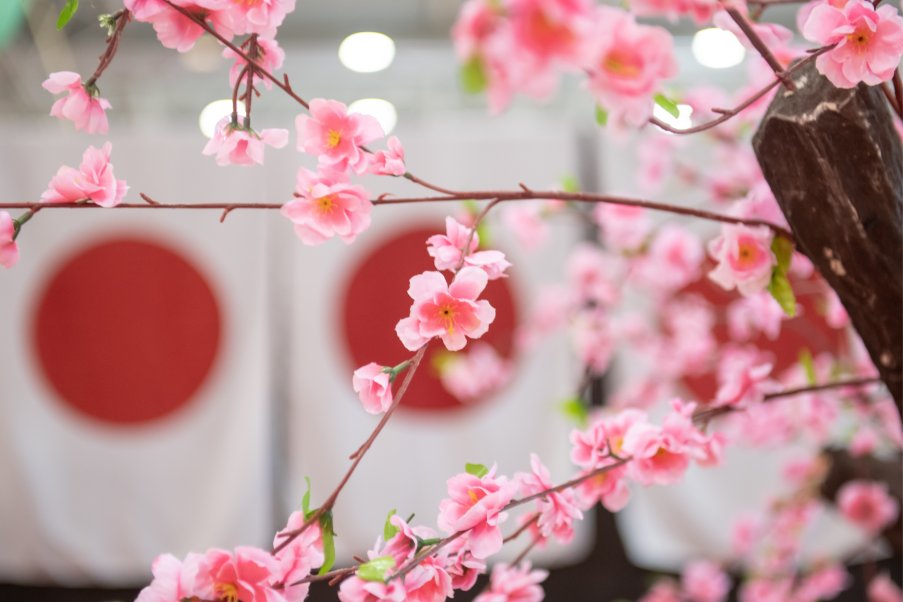
Hanami in Okinawa, sustainable tourism and well-being in southern Japan.
While much of the country awaits the end of winter, Hanami in Okinawa begins in January with the Kanhizakura variety, an intense pink that contrasts with the blue of the sea.
The ruins of Nakijin Castle, a World Heritage Site located in the historic village of Nakijin, on the Motobu Peninsula, offer a unique experience in which history and nature interact in silence. Contemplating the cherry blossoms among the limestone walls of the ancient Ryukyu Kingdom is like traveling to a time when these islands formed an independent and cosmopolitan state.
Okinawa, considered one of the “Blue Zones,” redefines luxury through well-being. Here, sustainable tourism in Japan is expressed through:
- Local gastronomy based on locally sourced products.
- Communities that practice yuimaru, or mutual support.
- Traditional crafts such as Bashofu weaving.
Exploring the Yanbaru region, a protected ecosystem, allows connection with a model of regenerative tourism where positive impact is part of the experience.
Hanami here is intimate. Slower. More authentic.

The millennial cherry tree of Yamanashi, a slow travel experience in Japan.
In Yamanashi Prefecture, at the foot of the northern slope of Mount Fuji (the other half belongs to Shizuoka Prefecture), at 3,776 m high, the highest peak in Japan, stands the Yamataka Jindai Sakura, considered the oldest cherry tree in Japan, at over 2,000 years old.
Its twisted trunk and branches supported by wooden structures form a natural sculpture that imposes a reverential silence.
It is a specimen of the Edo-higan variety. It is said to have been planted by Prince Yamato Takeru in the 1st century, making it one of the three “Great Cherry Trees” protected by the government as a National Natural Treasure.
It stands about 10 meters tall, with a trunk circumference of nearly 12 meters. Due to its advanced age, its heavy branches are supported by a network of wooden props, an image that symbolizes the extreme care the Japanese show for their environment.
Its conservation involves biological techniques, access control, and responsible environmental management. It is an example of how sustainable tourism and slow travel in Japan can coexist with preservation.
This tree is not just a natural symbol. It is a living monument.
Visiting it is an exercise in humility. A reminder that true luxury is time and contemplation.

Japanese Alps, slow travel, nature, and sustainable tradition.
In the heart of the Japanese Alps, Hanami takes on a different dimension. Here, the experience is built among mountains, historic villages, and living traditions.
The Japanese Alps form an imposing mountain range that crosses the island of Honshu, dividing the country like a backbone. They are structured into three major ranges: the Northern Alps (Hida), the Central Alps (Kiso), and the Southern Alps (Akaishi).
Walking the Nakasendo Route, one of the five great roads of the Edo period that connected the shogunate capital, Edo (present-day Tokyo), with the imperial capital, Kyoto, allows visitors to immerse themselves in an authentic experience of historical hiking and rural tourism, thanks to its carefully preserved and restored sections.
It is also possible to explore national parks such as Kamikochi, in Nagano Prefecture, where immersion in nature is combined with a minimal environmental footprint. All of this takes place in a region that stands out for its sustainable architecture, represented by gassho-zukuri houses, and for its zero-kilometer gastronomy.
Among the places that best define this region are:
- Kamikochi, an alpine valley where private vehicle access is restricted.
- Shirakawa-go, a World Heritage Site with architecture adapted to extreme climates.
- Takayama, a historic city in Gifu Prefecture, with neighborhoods from the Edo period.
- Nakasendo Route, one of the most authentic slow travel experiences.
- Matsumoto Castle, located in the city of Matsumoto, in Nagano Prefecture, a historic symbol known as the Black Crow.
- Tateyama Kurobe Alpine Route, an example of sustainable mobility in high mountain areas, crossing the Northern Japanese Alps and connecting the city of Toyama (in Toyama Prefecture) with the town of Omachi (in Nagano Prefecture).
This model shows that traveling slowly is not about giving anything up, but about deepening the experience.

Goryokaku in Hokkaido, the geometry of sakura and responsible tourism.
Our proposal culminates in the north, on the island of Hokkaido, where spring arrives in a late burst.
Goryokaku Fort, with its star shape, hosts more than 1,600 cherry trees. From its observation tower, the landscape transforms into a perfect composition of nature and design, where human geometry merges with blooming.
At the end of the cycle, the Hana-ikada phenomenon occurs, when petals float on the water. A visual spectacle that reminds us that beauty is not possessed, it is contemplated.
Hakodate is a walkable city with a strong historical character. Its tram system allows sustainable travel, connecting the fort with the Motomachi district, where churches and consular buildings coexist, evoking its cosmopolitan past.
Here, the experience is completed with sustainable mobility and local gastronomy that supports the local economy.

Traveling to Japan in spring, a conscious luxury experience.
Hanami is much more than a tradition. It is a way of understanding time, beauty, and travel.
To preserve this experience, travelers must adopt a responsible attitude. From Biosphere, we propose traveling by adopting basic principles such as:
- Respecting trees and their natural cycle.
- Avoiding waste and using reusable materials.
- Prioritizing public transportation.
- Supporting the local economy.
Sustainable Hanami is not a trend, it is a necessity.
Choosing less crowded destinations and practicing sustainable tourism in Japan transforms the journey into something deeper. Because true luxury lies not in exclusivity, but in connection.
Traveling to Japan during cherry blossom season is, in essence, an act of contemplation. And doing so with respect is the only way to ensure that this beauty continues to exist.


